.png)


CSE316 OPERATING SYSTEM
SESSION 2013-2014

CSE316: OPERATING SYSTEM CONCEPT
Time Allowed: 03:00
hrs
Max. Marks: 100
PART A
Q1 (a)
Give an abstract view of components of a computer system.
(b) Job of Security is to defend a system from external and internal attacks. Comment?
(c) Differentiate between preemptive and non-preemptive scheduling?
(d) What is busy waiting?
(e) What is Difference between Deadlock avoidance and Deadlock prevention?
(f) List the names of attributes which are helpful in identifying files.
(g) What do you mean by Dynamic Linking and Dynamic Loading?
(h) What are the solution of external fragmentation?
(i) What are two limitation of using pipes in IPC?
(j) What do you mean by file descriptors?
(b) Job of Security is to defend a system from external and internal attacks. Comment?
(c) Differentiate between preemptive and non-preemptive scheduling?
(d) What is busy waiting?
(e) What is Difference between Deadlock avoidance and Deadlock prevention?
(f) List the names of attributes which are helpful in identifying files.
(g) What do you mean by Dynamic Linking and Dynamic Loading?
(h) What are the solution of external fragmentation?
(i) What are two limitation of using pipes in IPC?
(j) What do you mean by file descriptors?
PART B
Q2 (a) Explain the methods through which the
user interacts with the operating systems?
OR
(b) What do you mean
by operating system? Explain the structure of various operating systems.
Q3 (a) Write a program
for listing all environment variables.
OR
(b) Explain Memory
Layout of C program with Suitable Examples.
Q4(a) Consider a
following Page String : 1,2,4,3,2,1,5,6,2,1,2,3,7,6,3,2,1,2,3,6
How many page fault
would occur for the LRU Replacement algorithm assuming two, three frames? Initially
all frames are empty.
OR
(b) Compare paging
with segmentation with respect to the amount of memory required by the address
translation structures in order to convert virtual addresses to physical
addresses.
Q5 (a) In almost every
case many files are stored on the same disk. The main problem is how to
allocate space to these files so that the disk space utilized effectively and
files can be access quickly. Discuss the methods along with its advantage and
disadvantages in details.
OR
(b) (i) What is seek
time? Why rotation latency is usually not considered in disk scheduling?
(ii) Except FCFS, none
of the disk scheduling discipline is truly fair (starvation may occur) explain
why this assertion is true. Also explain why fairness is an important goal in
time sharing system.
Q6 (a) Write a short
note on following:
(i) Named Pipes
(ii) Pipes
(iii) popen and pclose
OR
(b) The parent process
passes the data or message to child process using the method of IPC. Explain
which method is used for this type of communication along with an example.
--End of Question Paper--
SESSION- 2014-2015
OR
SESSION- 2014-2015
CSE316: OPERATING SYSTEM CONCEPT
Time Allowed: 03:00 hrs Max. Marks: 100
PART A
Q1 (a) What is a system call?
(b) What are the different states in which a process resides until its execution is completed?
(c) What is context switching?
(d) What is role of long term scheduler?
(e) What are environment variable?
(f) What is dynamic memory allocation?
(g) How deadlocks are different from starvation?
(h) Draw the wait-for-graph corresponding to this resource allocation graph. Find out whether there is is a deadlock or not?

(i) What is the deference between logical and physical address?
(j) What do you mean by external fragmentation?
(b) What are the different states in which a process resides until its execution is completed?
(c) What is context switching?
(d) What is role of long term scheduler?
(e) What are environment variable?
(f) What is dynamic memory allocation?
(g) How deadlocks are different from starvation?
(h) Draw the wait-for-graph corresponding to this resource allocation graph. Find out whether there is is a deadlock or not?
(i) What is the deference between logical and physical address?
(j) What do you mean by external fragmentation?
PART B
Q2 (a) List five services provided by an operating system. Explain how each provides convenience to the users. Explain also in which cases it would be impossible for user-level programs to provide these services.
OR
(b) What are difference between user level thread and kernel level threads
Q3 (a) Consider the following scenario of five processes with priority, burst and Arrival Time Calculate average waiting time and average turn around time by showing Gantt-Charts for
Process Priority Burst time Arrival Time
P1 10 3 0
P2 3 1 5
P3 2 3 2
P4 1 5 3
P5 5 2 1
i. Priority scheduling with PREEMPTIVE.
ii. Priority scheduling without PREEMPTIVE.
Process Priority Burst time Arrival Time
P1 10 3 0
P2 3 1 5
P3 2 3 2
P4 1 5 3
P5 5 2 1
i. Priority scheduling with PREEMPTIVE.
ii. Priority scheduling without PREEMPTIVE.
OR
(b) i) Explain the differences with diagram between multilevel queue and multilevel feedback queue scheduling.
ii) Explain with example how the behavior variate when the time quantum for round robin scheduling is large or small.
ii) Explain with example how the behavior variate when the time quantum for round robin scheduling is large or small.
Q4(a) Explain Banker's algorithm or deadlock avoidance with multiple instance of a recourse in detail with the help of example.
OR
(b) Explain the following desk scheduling algorithms with the help of an example.
i) FCFS ii) SSTF iii) SCAN
i) FCFS ii) SSTF iii) SCAN
Q5 (a) i) What is virtual memory? How demand paging supports the virtual memory? Explain in detail.
ii) How segmentation supports user view of memory?
ii) How segmentation supports user view of memory?
OR
(b) Consider the following page reference string:
1,2,3,4,2,1,5,6,2,1,2,3,7,6,3,2,1,2,3,6
How many page faults would occur for the following page replacement algorithm assuming three as frame size? Remember that all frames are initially empty.
i) LRU replacement
ii) FIFO replacement
iii) Optimal replacement
1,2,3,4,2,1,5,6,2,1,2,3,7,6,3,2,1,2,3,6
How many page faults would occur for the following page replacement algorithm assuming three as frame size? Remember that all frames are initially empty.
i) LRU replacement
ii) FIFO replacement
iii) Optimal replacement
Q6 (a) Explain all the techniques dealing with inter process communication in detail.
OR
(b) Write a program to show the usage of popen() and pclose(). Discuss with the expected outcome.
DOWNLOAD STUDY MATERIAL
--End of Question Paper--
CSE306 COMPUTER NETWORKS

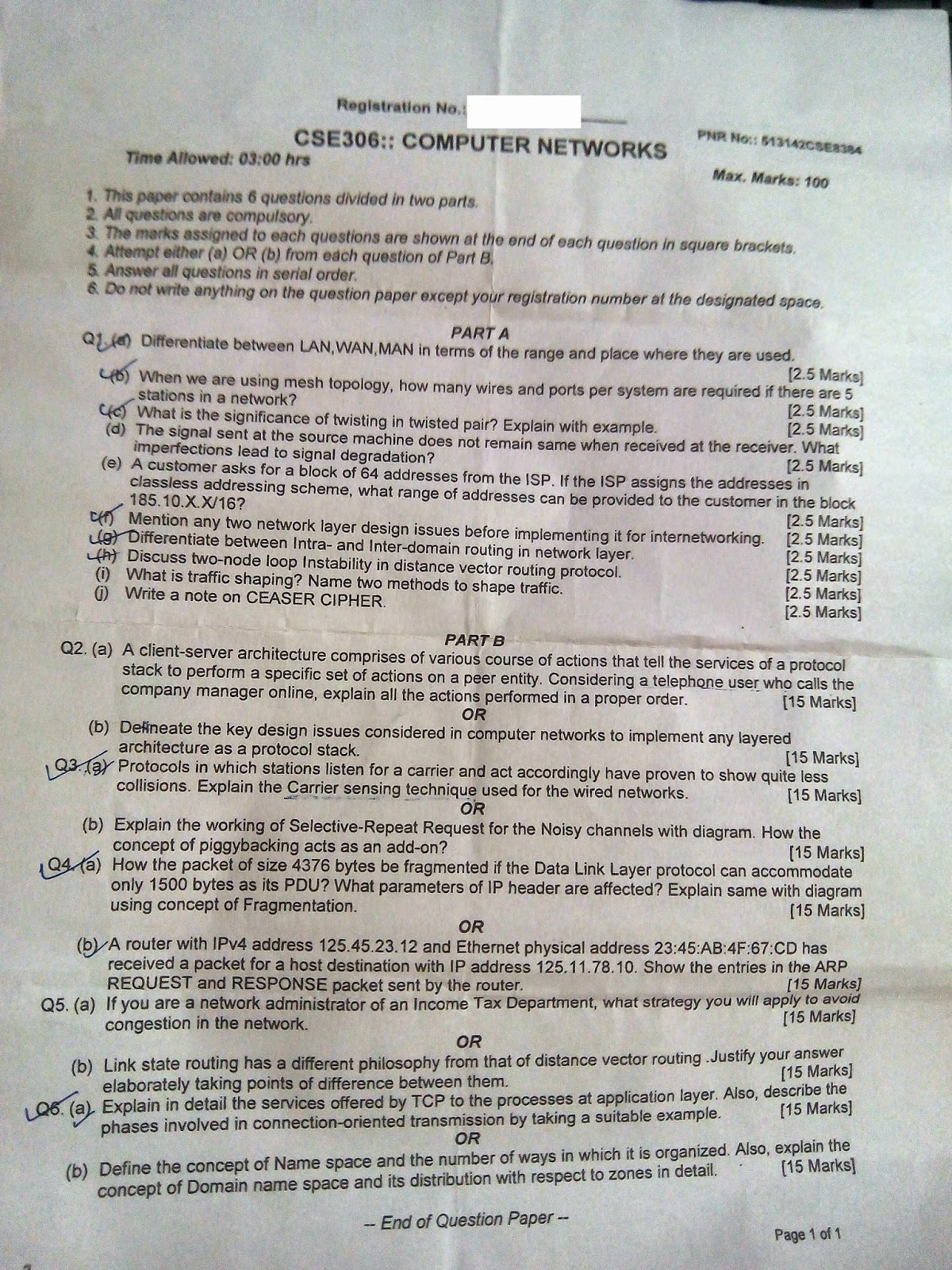
Course:CSE306::COMPUTER
NETWORKS
Time Allowed:
03:00 hrs Max. Marks: 100
1.
This paper contains 6 questions divided in two
parts.
2.
All questions are compulsory.
3.
The marks assigned to each questions are shown
at the end of the question in square brackets.
4.
Attempt either (a) OR (b) from each question of
Part B.
5.
Answer all the questions in serial order.
6.
Do not write anything on the question paper
except your registration number at the designated space.
PART A
Q1.
a)
Differentiate between LAN, WAN, MAN in terms of
the range and place where they are used.
b)
When we are using mesh topology, how many wires
and ports per system are required if there are 5 stations in a network?
c)
What is the significance of twisting in twisted
pair? Explain with example.
d)
The signal sent at the source machine does not
remain same when received at the receiver. What imperfections lead to signal
degradation?
e)
A customer asks for a block of 64 addresses from
ISP. If the ISP assigns the addresses in classless addressing scheme, what
range of addresses can be provided to the customer in the block classless
addressing scheme, what range of address can be provided to the customer in the
block 185.10.X.X/16?
f)
Mention ant two network layer design issues
before implementing it for internetworking.
g)
Differentiate between intra- and inter-domain
routing in network layer.
h)
Discuss two-node loop Instability in distance
vector routing protocol.
i)
What is traffic shaping? Name two methods to
shape traffic.
j)
Write a note on CEASER CIPHER.
PART B
Q2.
a)
A client-server architecture comprises of
various courses of actions that tell the services of a protocol stack to perform
a specific set of actions on a peer entity. Considering a telephone user who
calls the company manager online, explain all the actions performed in a proper
order.
OR
b)
Delineate the key design issues considered in
computer networks to implement any layered architecture as a protocol stack.
Q3.
a)
Protocols in which stations listen for a carrier
and act accordingly have proven to show quite less collisions. Explain the
Carrier sensing technique used for the wired networks.
OR
b)
Explain the working of Selective-Repeat Request
for the Noisy channels with diagram. How the concept of piggybacking acts as an
add-on?
Q4
a)
How the packet of size 4376 bytes be fragmented
if the Data Link Layer protocol can accommodate only 1500 bytes as its PDU?
What parameters of IP header are affected? Explain same with diagram using
concept of Fragmentation.
OR
b)
A router with IPV4 address 125.45.23.12 and
Ethernet physical address 23:45:AB:4F:67:CD has received a packet for a host
destination with IP address 125.11.78.10. Show the entries in the ARP REQUEST
and RESPONSE packet sent by the router.
Q5.
a)
If you are a network administrator of an income
tax department, what strategy you will apply to avoid congestion in the
network.
OR
b)
Link state routing has a different philosophy
from that of distance vector routing. Justify your answer elaborately taking
points of difference between them.
Q6.
a)
Explain in detail the services offered by TCP to
the processes at application layer. Also, describe the phases involved in
connection-oriented transmission by taking a suitable example.
OR
b)
Define the concept of Name space and the number
of ways in which it is organized. Also, explain the concept of Domain name
space and its distribution with respect to zones in detail.
--End of Question
Paper--
Subscribe to:
Posts (Atom)
Popular Posts


Popular Posts
-
 SESSION 2013-2014 CSE316: OPERATING SYSTEM CONCEPT Time Allowed: 03:00 hrs ...
 -
 Third type of sequence statement 1) goto statement: it transfer the flow of control to the label unconditionaly. syntex: goto ; ...
 -
 step1: open youtube step2: type "use the force luke" in the search box step3: press enter AND SEE WHATS HAPPEN ...

